
Core Teaching of Buddhism
Dharma Talk by
Rev. Takashi Maeda, Director, Rissho Kosei-kai International
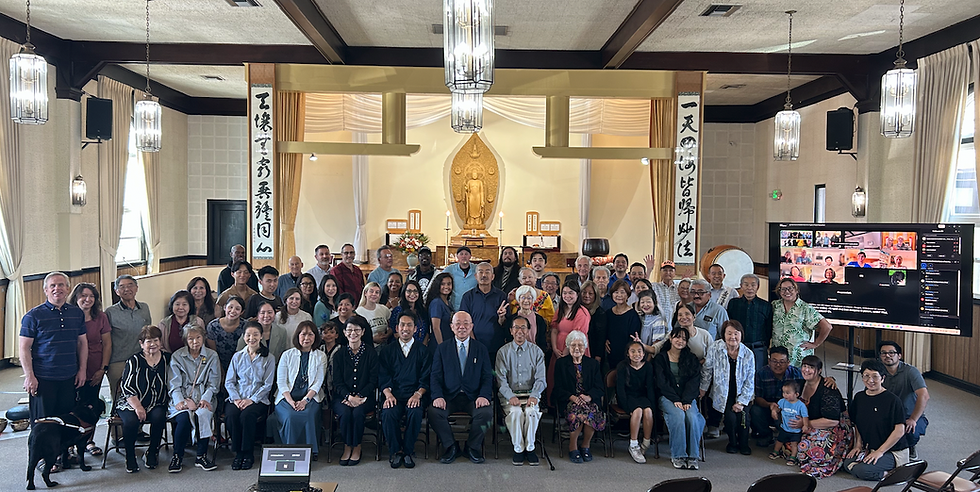
*This dharma talk was delivered at RKLA on March 29, 2026
Hello everyone, I’m technically a third-generation member of Rissho Kosei-kai, but if you look back at my family tree, things start to look a little... different.
As it turns out, I’m actually a "third-generation entertainer," too! Here’s the deal: my connection to Koseikai started back in 1954 when my grandmother joined because she wanted to honor our ancestors.
Growing up, she used to tell me stories about how our ancestors a few generations back were actually traveling performers—touring actors who spent their lives on the road.
My grandma, my mom, and all their siblings were such bright, cheerful people. Whenever someone dropped by the house, they’d immediately serve tea and just listen. By the time the guests left, they were always laughing.
When I was a kid, I used to wonder, "Why are there always so many people coming over?" But looking back, I realize they were just people who truly loved making others happy.
So, sure—on paper, I’m third-generation Koseikai. But deep down in my DNA? I’m a third-generation entertainer. So, the real starting point for the path I’m on today goes back to a summer break when I was a high school junior.
I went with some friends from my sangha to volunteer at the home of an elderly woman who lived alone. She had lost her husband in the war and had actually lost her right leg in an injury as well.
When I looked into her kitchen, I noticed she didn't even have a place to put her pots—they were all just lined up on the floor.
I thought, "Man, this is rough,"
so we decided to build her a shelf.
But, keep in mind, we were just high schoolers. We didn't know the first thing about carpentry! We’d hammer a nail, it would bend, and we’d pull it out.
Hammer another, it would bend, pull it out. Before we knew it, there were more holes in the wood than nails.
I honestly thought, "The sun’s gonna go down before this shelf is ever finished."
Somehow, though, we got it done by evening. As we were getting ready to leave, she grabbed her crutches and came outside to see us off.
We said our goodbyes and started to pedal away on our bikes, and at that exact moment...
THUD.
We heard a sound and looked back. There she was, sitting right there on the ground, waving to us with tears streaming down her face. As a high school kid, I was floored. I couldn't believe that something we did could bring someone that much joy. Even now, 45 years later, that image is what keeps me going.
--

Takashi Yanase, the creator of the Japanese cartoon Anpanman, once wrote:
"Nothing makes a person happier than making someone else happy."
When I read that, it clicked.
I realized, "Ah, I’m living a life where I’m constantly chasing that kind of joy."
Think about it this way:
Would you rather live a life where you're always looking for a good meal for yourself?
Or a life where you're looking to give someone else a great meal?
Which one would you choose?
As our President Nichiko Niwano says...
"If you make it your mission to bring joy to others, anytime, anywhere, you can
become a Bodhisattva."
That’s exactly what I’m hoping for today. that our time together brings even a little bit of joy to your day.
--
Now, I want to share a story about a rather unique professor. He’s passed away now, but Professor Masahiro Mori wrote a book called The Recommendation of "Non-Seriousness", and in it, he shares a truly fascinating story. It’s about a fly.
I know, I know—talking about flies at a Dharma Center might seem a little weird! But honestly, it’s the perfect metaphor for Buddhism.
One day, there was this fly stuck inside a room. It looks out the window and sees the bright, beautiful blue sky.
The fly thinks, "Wow, it looks amazing out there! Alright, I’m heading out!"
Hey, great attitude, right? It's got a clear goal.
It takes off with all its might
SMACK!
Right into the glass.
The fly says, "That’s weird... let's try again!"
SMACK!
It hits it again. "No, no, I can do this!"
SMACK!
But here’s the crazy part. The fly starts thinking, "I guess I’m just not going fast enough." So it backs up all the way to the other side of the room to get a running start. "This is the one!!"
S-M-A-A-A-CK!!!
The fly tells itself, "I guess I’m just not working hard enough."
But it’s wrong! It’s not about effort. It’s about direction. It's heading the completely wrong way.
Still, the fly thinks, "If I just try harder, I'll get out!"
SMACK!
SMACK!
SMACK!
It’s working so hard. It’s so serious. It’s the most dedicated fly you’ve ever seen. But it’s not getting anywhere.
Now, looking at this, we all think, "Man, that fly is such an idiot, right?"
But... if you really think about it, we humans do the exact same thing. We say it all the time, don't we? "If I just work hard enough, I’ll figure it out." And sure, effort is important! But sometimes... we’re just pushing in the wrong direction.
Take a married couple having an argument, for example.
"Why don't you get it?!" SMACK!
"It’s your fault!" SMACK!
"I am definitely right about this!" SMACK!
Before they know it, they’re both just slamming their heads against the glass over and over.
It happens at work, too.
"We’ve always done it this way!" SMACK!
"This is the only way to do it!" SMACK!
"I know I’m right!" SMACK!
They’re stuck. But they keep grinding away. In Buddhism, we have a word for this: ATTACHMENT.
Professor Mori says: "The 'serious' fly will never get out." So, what do you do?
You become a "non-serious" fly.
And what does a non-serious fly do? After it hits the glass, it stops and goes, "...Wait, what?" and actually takes a step back. That’s the secret right there. When you step back, your field of vision opens up.
Suddenly, you notice, "Oh, hey! There’s a gap right over there," and—whoosh—you’re out.
It’s not that the fly got out because it stopped trying. It got out because it stepped back and finally saw the situation for what it was.
In Buddhism, we call this wisdom Prajna. It’s the wisdom of seeing things exactly as they are. The Buddhist path isn't about charging forward with brute force, but it’s not about doing nothing, either. It’s right in the middle.
It’s the Middle Way.
They say Buddhism is all about two things: Wisdom and Compassion.
Today, we learned a bit of wisdom from a fly. But what about compassion?
Personally, I think it’s the very fact that we’re here, being allowed to live our lives. Our very existence is an expression of the Buddha’s compassion.
In Japanese, we have the word ARIGATAI (thankful). If you look at the kanji, it literally means "difficult for it to be." In other words, the fact that we are alive right now is actually a "hard-to-happen" miracle. When you realize that, a sense of gratitude just naturally starts to bubble up.
I actually had a pretty strange experience with this a while back.
I was on the train heading home from work, and I decided to just keep saying "thank you" over and over in my head.
At first, I was just repeating the word. It didn't mean much. But then, something strange started to happen. I looked at the person sitting right in front of me, and I felt this genuine wave of "thank you" toward them.
A total stranger!
I got off the train and kept it going. "Thank you" to my bike. "Thank you" to the telephone poles.
At one point I even thought to myself, "Okay, I’m starting to turn into a bit of a weirdo here." But I kept on. "Thank you" to my front door. Then I saw my family and said, "Thank you." I ended up finishing that day feeling so incredibly full and at peace.
When I shared this story at the Aomori Church, a chapter leader named Noriko Kida took it to heart. She didn't just listen, she actually put it into practice with total sincerity.
But then, life hit her with one thing after another. An accident, a fire, a serious illness. it was just constant hardship. Yet, through it all, Noriko never stopped saying "thank you." Even when her house was literally burning down, she stood there saying "thank you" to the house, to the furniture, and to all the memories they held.
The house was a total loss. But in the aftermath, the sangha stepped up to support her, and she found herself surrounded by an incredible amount of kindness.
Then, they found the cancer. Even then, she kept saying "thank you." She told us:
"I’ve been through the accident, the fire, and the sickness, but because of them, I was able to truly feel the kindness of so many people. My life is honestly a miracle. I am so happy."
A little while later, she passed away, with her final words being an expression of gratitude to everyone around her.
Getting to know her really made me realize something:
no matter what kind of storm you’re walking through, if you can hold onto that sense of gratitude, you can live a truly happy life. I really believe that’s what the Buddha wants for all of us.
Even the fact that I got to meet all of you today is a total "miracle"—a true ARIGATAI moment.
So, here’s my challenge for you: before this day is over, try to share a genuine "thank you" with just one person. It doesn't have to be a big deal—just a small ripple of gratitude.
I think that’s exactly how we start spreading the Buddha’s compassion out into the world.
Thanks so much for listening.
--
Notes by Kyohei
The fly analogy is a powerful way of presenting the core teaching of Buddhism.
Point of practice: When things do not go in ways we want, we are invited to reflect on the present approach and then re-approach things in different ways.
Q. In the married couple's examples, what can be alternative ways of saying things?
Reaching the goal of, for instance, the absence of anger, is a wonderful thing. However, the most realistic approach to it would be to enjoy the process toward that goal: the very process of start paying attention to, noticing, and understanding the arising and perishing of anger is more essential. Once we let go of this goal and start shifting to focus on the process, that which you have let go of can start to be achieved.
This leads to an importance and the powerfulness of listening as a way of Buddhist practice that enriches your life. You can click the button below to move on to an example:


Comments