
How Buddhism Works in Reality
Kyohei Mikawa
Minister, Rissho Kosei-kai Buddhist Center of Los Angeles

This blog post presents a slightly revised version of my dharma talk from Ancestor Appreciation day at Rissho Kosei-kai Los Angeles, March 29, where the sangha learned Buddha's teaching of Six Paramitas.
--
Buddhism works. Today, let me show you how and why. I am going to talk about:
1) Buddha’s teaching of the Six Paramitas;
2) what the Lotus Sutra added to it; and
3) how I experienced what the Lotus Sutra is saying about it.
Through offering this, my hope for us is to deepen our understanding of how the wondrous Dharma of the Lotus Sutra helps us and takes care of our worries when we wholeheartedly help others to take care of their concerns for a long time. Let's unpack this one by one.
1. The Six Paramitas

In our Buddhist practice, what we want is the 5th of the sixfold practice (see the picture above): a meditative state of mind that is free from attachments and one-sided views. From that position of clarity, we can make sound decisions: that’s wisdom. In the US, many people come to Buddhism for meditation. But when they try, they feel that meditation was impossible because too many thoughts come and cannot focus.
Disturbing thoughts that emerge during a meditation session are most of the time self-centered thoughts about ourself. The Six Paramitas explains that in order to get to the meditative state of mind, before doing meditation, we first must prepare a condition of meditation by beginning with creating a habit of thinking about the happiness of others.
Attempting to meditate first and end up getting frustrated resemble to trying to plant a seed in a hard soil without cultivating it first. Seeds won’t grow if planted in uncultivated soil. Similarly, generosity practice is a powerful tool that cultivates our heart, and prepares a condition for meditation. That needs to be the entry-point to our meditation. In this sense, our Buddhist practice is like a spiritual farming practice: you do the work, and you harvest the results, while the Buddha and Dharma will take care of this process with the support of sangha—dharma family.
The ideal is to go from generosity straight to meditation, but we all know that unexpected things happen in life. Because of that we need an assistance from precept keeping; forbearance; and diligence to keep our practice of generosity going. That’s how all the six hang together.
2. What the Lotus Sutra added to it
The Six Paramitas is one of the classical teachings of the Buddha. To this classical teaching, the Lotus Sutra added something else, or more precisely speaking, the sutra unfolded the unseen aspect of this practice. The Lotus Sutra was composed after the Buddha’s all classical teachings were laid out. The sutra revealed what our practice of classical teachings is really doing to people around you, and for you. This “what is really happening” is something we cannot see when it is brewing and developing.
In our everyday life, many of us have worries about ourselves. It is rare to feel wholly free from any worries about one's own life. What can we do about it? The Lotus Sutra teaches that our worries are taken care of without being sought when we wholeheartedly practice the selfless virtuous deeds of Six Paramitas for a long time.
The Lotus Sutra brings this unseen aspect of our practice to light so that we can see it and experience it.
This is interesting or perhaps counter-intuitive: What you seek is to help taking care of concerns others have, but what you actually attain is both their concerns and your concerns being taken care of at the same time as a result of your generosity practice. This is beyond a regular conception of how causality works. Nevertheless, this is how the WONDROUS world of the Lotus Sutra expresses itself. Dharma takes care of our worries. That’s what the Lotus Sutra revealed about the Six Paramitas.
*Notes: This is how the Lotus Sutra elaborates the Buddhist causation “dependent origination.” In the Lotus Sutra, it seems like seen causal phenomena based on one’s generosity practice takes place while an unseen activity of Dharma is at work toward liberation of the practitioner of generosity and its receivers. The two—the seen and unseen activities—seem to be disconnected, but in ways that are unseen, they go hand in hand, as the Lotus Sutra’s teaching of Ten Suchnesses express: the ultimate identity of all things.
3. Story: my experience of how the Lotus Sutra works in reality
I love my job as a minister. Thank you for welcoming me into your dharma family two years ago. I want to believe that the mission of my present lifecycle is to spread the teachings of the Lotus Sutra in this country and grow with everyone who is on board with it for the rest of my life. But I have been constantly worried about one thing that is beyond my control: my visa expiration that will occur in three years.
During the last two years, my everyday life is composed of visiting a member’s house for prayer service, enshrinement, doing hoza and recitation in this sanctuary during weekdays with Japanese members, doing sangha Sunday, having various meetings, calling and texting members, offering class on Tuesdays, striking singing bowls on Thursday nights, welcoming new friends, doing social media marketing, creating new ways of reaching people, and attending US minister’s meeting. I do this all with all of you. I love doing all of these, and these are the forms of generosity practice that I can offer.
Going back to my visa-related worry, all of my family and I were all born in Japan. After Rissho Kosei-kai headquarters appointed me as a minister, we moved to LA with a “religious worker’s visa.” The US government’s law says this visa is only valid for 5 years. After the 5 years pass, a visa holder must leave the US at least for one year before re-applying and attaining religious worker’s visa again. But a famous loophole is to attain a green card for unlimited stay before the religious worker visa expires. But bad news is that according to my immigration lawyer, current wait time for green card for my work category is 7 years.
Since I moved to LA, 2 years have just passed. After three years from now, I would have to get out of this country with my family at least for one year. If I leave, there is no guarantee that I can come back to LA because it involves a lot of factors that are beyond my influences. I was uncertain but it was totally way beyond my control. But I had a faith in the process and thought:
“Let me test if the Lotus Sutra’s teaching is true. I know I have been practicing generosity with my dharma family intensively for the last two years. Let me see how the wondrous dharma takes care of my worries, as I continue offering my generosity practice wholeheartedly.”
Just recently, my wife Emily and I had a meeting with our immigration lawyer. On the call, he said:
“A couple of weeks ago, the US government removed the one-year rule for religious workers visa. This means you can renew your visa without having to leave this country for one year anymore. I have never seen this kind of change of law during decades of my carrier as an immigration lawyer. Perhaps this is something that happens once in a century. This is excellent news for you.”
This surprising news made me overjoyed and made me feel that this wondrous dharma of the Lotus Sutra can take care of our worries as long as we are committed to the practice of generosity without being swayed. The government may change this new visa rule in the future, but it doesn’t matter to me anymore.
Through this wondrous experience, I felt as if the Buddha was saying to me, “Good job. Keep going without worrying.” To my surprise, it also removed my attachment to spreading the dharma in this country. Now I feel that no matter where I may be in the future, that’s the best environment for my soul’s journey in this lifetime. But my hope is still to grow the community of the Lotus Sutra with you in this country.
This is how our selfless practice that you can see can take care of your concerns in ways that are unseen. This is how the various generosity practice can unfold the wondrous dharma of the Lotus Sutra. Many of you ask me, "Why do these Japanese senior members remain as active members of our sangha for over 30 or 40 years?" The answer is that they practiced Six Paramitas for a long time and experienced how the wondrous dharma actually takes care of everyone's worries. They are just happy with their encounter with the world of the Lotus Sutra.
Today, you chose to show up. Your presence is a gift for all participants. Many of you came early to help us. Another form of generosity. Your attentive listening is generosity. You are already engaged in this practice.
Let me end there.
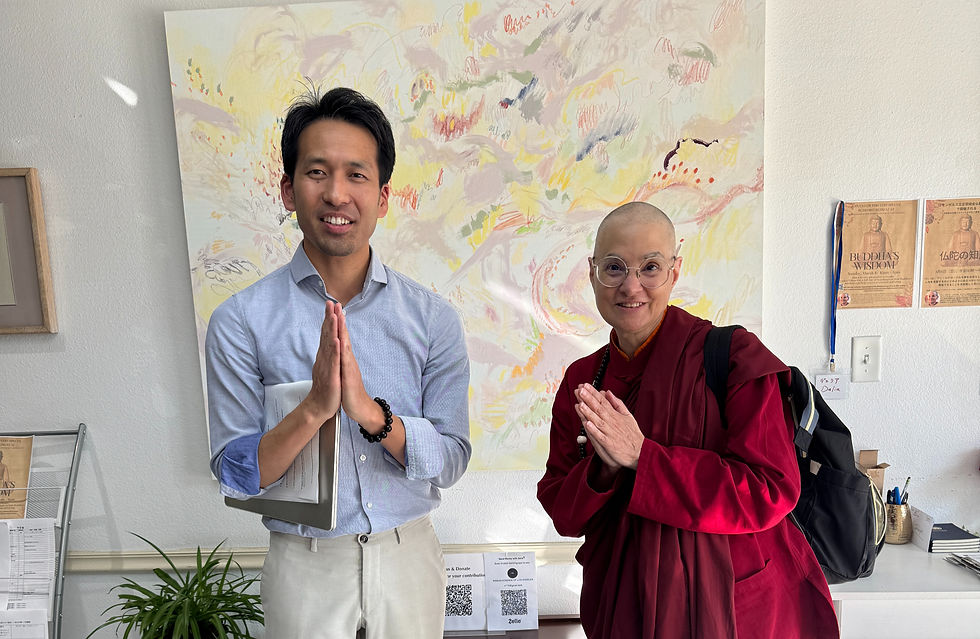
p.s. Taking up the topic of Six Paramitas was inspired by our dharma friend Ani Lodro Palmo, Director of Vajra Vidya Retreat Center in Crestone, CO.


Comments